
Kitchidi
Rice and Lentils porridge and Sizzling Spices: An Ayurvedic Reset

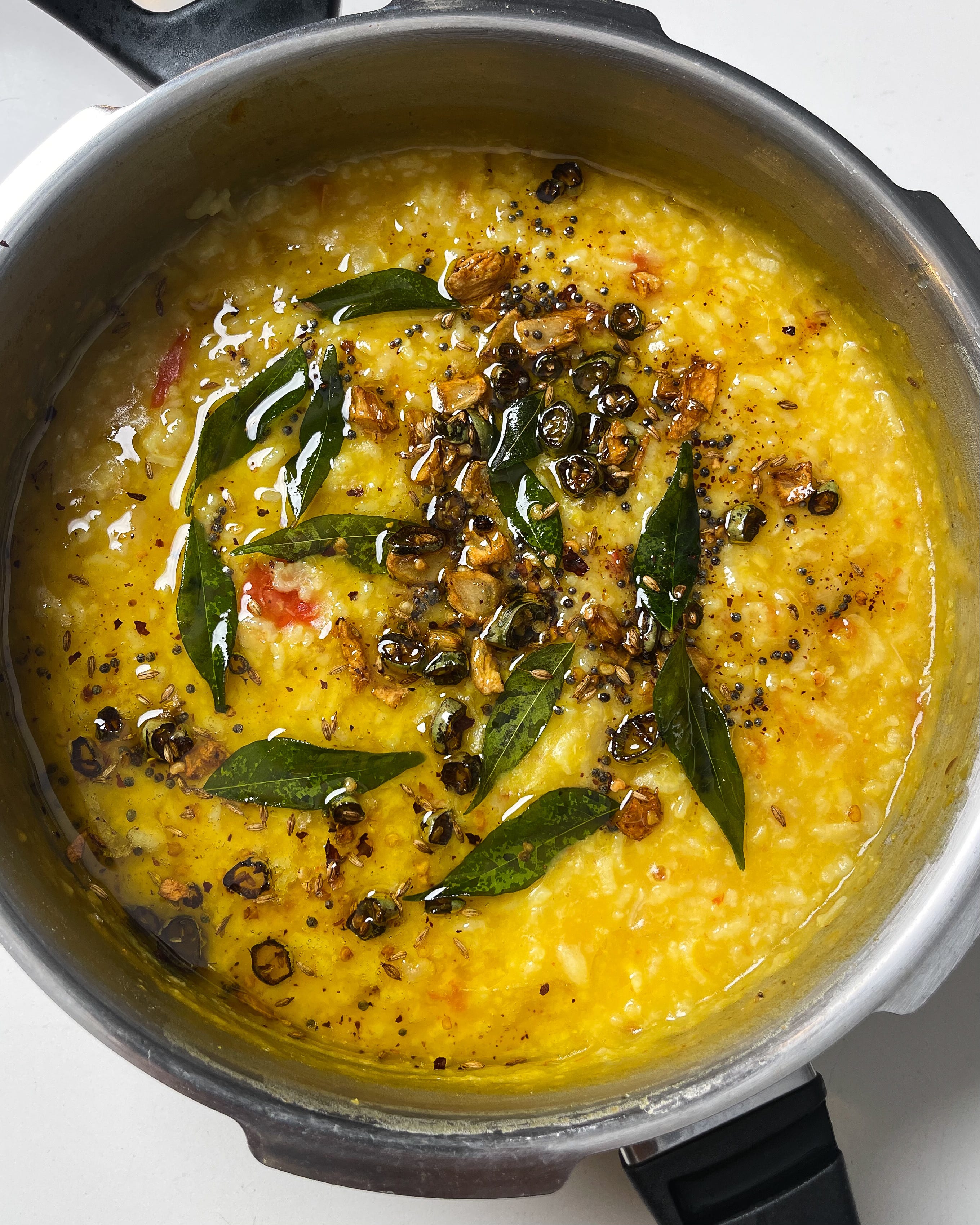
There is a specific kind of quietude that only a bowl of Kitchari can provide. In the landscape of savory, spicy foods, Kitchidi stands as the grounding force, a dish that doesn’t demand your attention with aggressive heat, but rather envelopes you in a warm, golden hum. For so many, this is the taste of childhood nostalgia. It is the South Asian equivalent of a hug; the meal you were fed when you were sick, when the weather turned, or when the world felt like too much. Much like congee is to East Asian households, Kitchidi is the humble, reliable backbone of the South Asian home. It is a dish that has fed generations, transcending class and region, proving that the simplest combination of grain and pulses is the simplest yet satisfying bowl of sustenance.
But Kitchidi is also the cornerstone of Ayurveda, it is a deeply healing and easily digestible and balancing meal made with humble ingredients. So it’s impossible to talk about its healing properties today without acknowledging how the West has colonized the practice. In recent years, Kitchidi has become the poster child for wellness influencers and their brands. We’ve seen it stripped of its cultural lineage, repackaged as “clean eating” or “detox” trends, and sold back to us in expensive powders and minimalist jars. In this transition, the depth of the practice is often lost. Ayurveda isn’t a luxury aesthetic or a trendy January reset; it is a practical, ancestral wisdom born from the Indian subcontinent. When we cook Kitchidi, we aren’t just making a “wellness bowl”, we are participating in a tradition that has sustained people for millennia, long before it was ever “discovered” by the West.
The beauty of Kitchidi lies in its structural simplicity. We use a blend of white rice, toor dal, and moong dal, simmered together until the grains lose their individual edges and merge into a soft, porridge-like consistency. You could just use one dal and that would work too with a 1:1/2 ratio. Unlike a biryani where every grain must be separate, Kitchidi thrives on unity. The base is built on a gentle foundation of turmeric, ginger, garlic, and onion, aromatics that provide a subtle, earthy glow.
But the soul of the dish is found in the Tadka. This is where we introduce the savory, spicy elements I love so much. By tempering mustard seeds, cumin, fresh green chilies, and curry leaves in hot fat, we create a high-voltage oil that wakes up the entire bowl. When that sizzling Tadka hits the soft rice and lentils, it releases a fragrance that is both nutty and bright. It provides the necessary contrast to the creamy base, ensuring every spoonful has a moment of toasted spice.
To finish, we look to the sides for the final punch. A handful of fresh cilantro brings a burst of green, and a cooling dollop of yogurt balances the heat. But it’s the Achaar (Indian pickle) and a shattered, crispy papad that complete the experience. The spicy, and salty hit of pickle combined with the crunch of the papad cuts through the buttery richness of the Kitchidi. It is a meal that proves you don’t need a long list of ingredients to create a dish that feels entirely whole. It is a savory, nostalgic hug from the inside out.
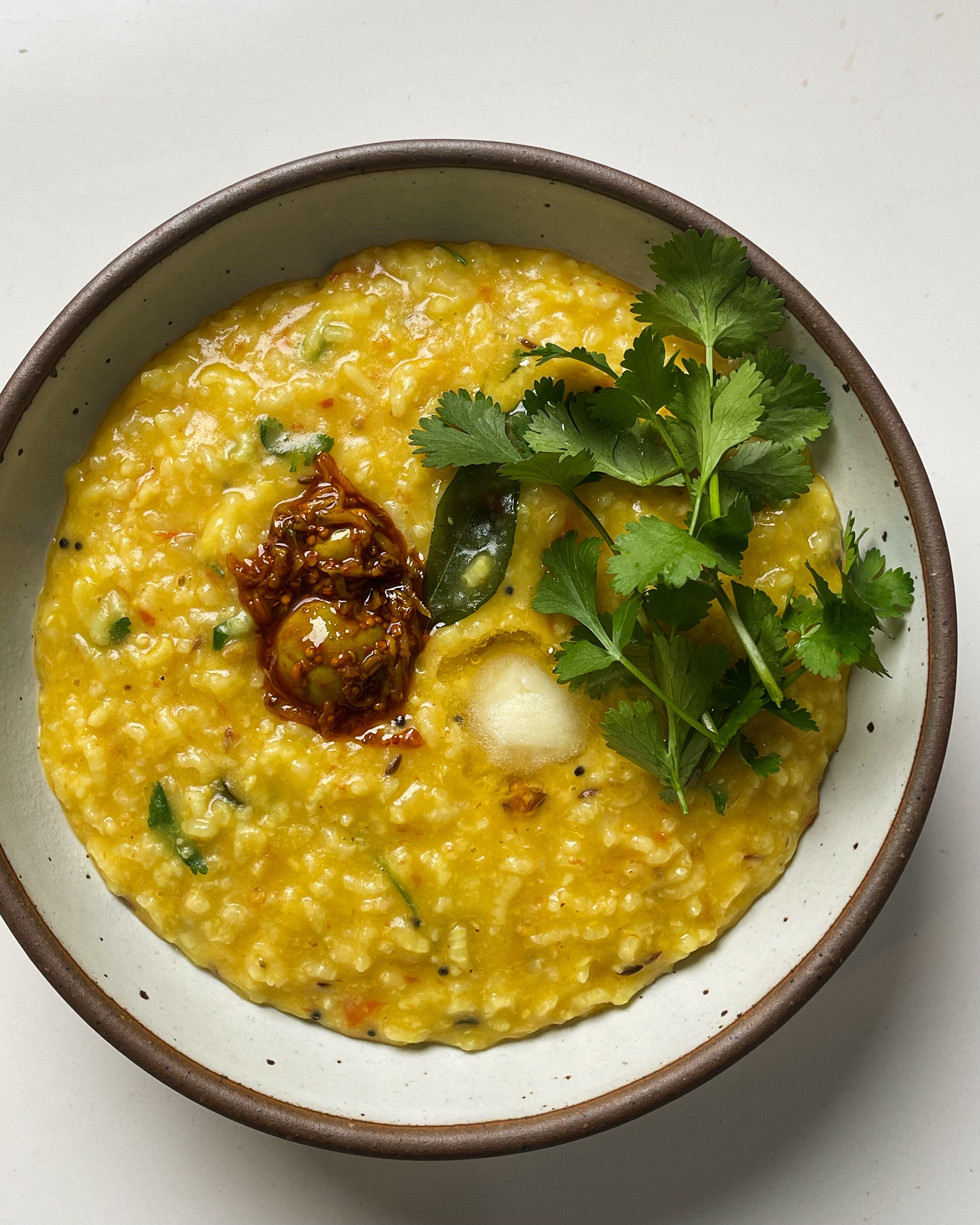
2-3 servings / Time - 45 min
INGREDIENTS
1 cup short grain white rice
1/4 cup yellow or green moong dal
1/4 cup yellow toor dal
2 tbsp neutral oil or ghee
4 garlic cloves, minced
1 (1 inch) piece ginger, minced
1/4 tsp hing (asafoetida)
1/2 tsp cumin seeds
1 small red or white onion, chopped
1 red tomato, chopped
1 tsp turmeric powder
5–6 cups water
Salt to taste
The Tadka (The Temper)
2 tbsp neutral oil or ghee
1 tsp black mustard seeds
1 tsp cumin seeds
3–4 Thai green or red chiles, chopped
4 garlic cloves, peeled and smashed or roughly chopped
1/4 tsp hing
1/2 tsp red pepper flakes (optional)
2 sprigs fresh curry leaves
METHOD
Step 1: Rinse the rice and both dals together until the water runs clear. Drain and set aside.
Step 2: In a large pot or pressure cooker, heat 2 Tbsp oil or ghee over medium heat. Add the hing and 1/2 tsp cumin seeds. Once they sizzle, add the onion and sauté until translucent.
Step 3: Stir in the minced garlic and ginger, cooking for about a minute. Add the chopped tomato and turmeric, and sauté for 2–3 minutes until the tomatoes begin to break down.
Step 4: Add the rinsed rice and dal mixture. Pour in 1 1/2 quart water and add salt. Bring to a boil, then reduce heat to low, cover, and simmer for 30–40 minutes (or 3–4 whistles in a pressure cooker) until the texture is soft and porridge-like. Stir in more hot water if needed to reach your preferred consistency.
Step 5: Prepare the tadka right before serving. In a small skillet or tadka pan, heat 2 Tbsp oil or ghee over medium-high heat.
Step 6: Add the mustard seeds. Once they pop, add the cumin seeds, chiles, smashed garlic, hing, and red pepper flakes.
Step 7: Drop in the curry leaves last, letting them sizzle and crisp for 30 seconds. Pour the hot, fragrant tadka immediately over the cooked kitchari.
Step 8: Serve hot, topped with fresh cilantro and sides of achaar, yogurt, and papad.